Every spring, something happens across the Central Coast that most homeowners don't notice. Mature termite colonies send out winged termites to start new nests, usually on warm, humid days after rain. In Australia, this swarming mostly happens from late spring into early summer.
You might spot it as a pile of tiny translucent wings on a windowsill, near an outdoor light, or scattered across your deck. It's easy to sweep up and forget about. But the timber structures around your home — your deck, pergola posts, subfloor and fences — are the first things a new colony will find.
We're carpenters, not pest controllers. What we do see, constantly, is the damage left behind. After 20 years building on the Central Coast, we've pulled apart plenty of decks where the boards looked fine and the frame underneath had been eaten hollow.
Here's what to look for, and what to do if you find something.
Why decks and subfloors are the first place termites look
Termites want three things: timber, moisture and a way in that keeps them out of sight. A typical Central Coast deck offers all three.
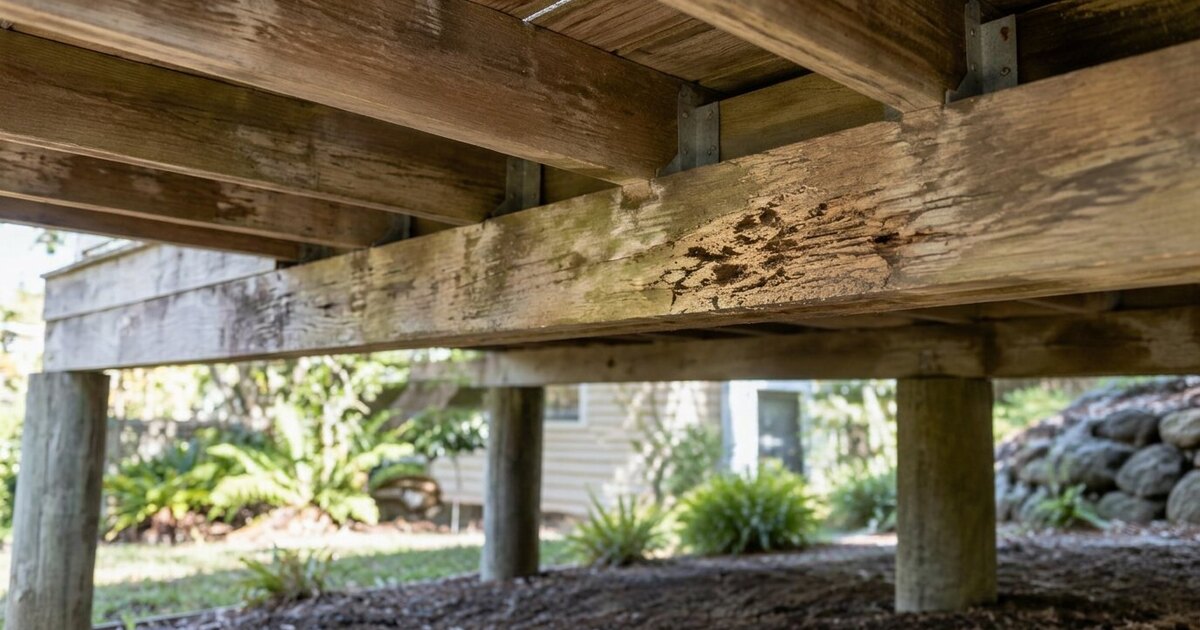
The frame is hidden. You see the decking boards. Termites eat the bearers, joists and posts underneath, where nobody looks.
It's damp underneath. Shaded, poorly ventilated space under a deck holds moisture, especially after our wet winters and summer storms.
It's often close to soil. Posts near or in the ground, garden beds pushed up against the structure, and clearance that's too tight all give termites a protected path up into the timber.
It can bridge your home's termite protection. This one catches people out. If your house has a termite management system, structures like carports, pergolas and fences attached to the house can bridge that barrier and let termites straight past it. A deck built the wrong way can undo the protection your home already has.
Seven signs of termite damage in timber structures
1. Hollow-sounding timber. Tap along your bearers, joists and posts with a screwdriver handle. Solid timber gives a dull thud. Damaged timber sounds hollow or papery.
2. Timber that gives way. Push a screwdriver into the underside of joists and bearers, especially near ground level and where posts meet the ground. If it sinks in easily, something is wrong. It's either termites or rot, and both need fixing.
3. Mud tubes. Pencil-width tunnels of dried mud running up piers, posts, brickwork or the inside of a subfloor wall. Termites build these to travel under cover. Don't break them open.
4. Discarded wings. Piles of small, identical wings on windowsills, near lights or on the deck after a warm, humid evening. Where the wings land is usually where a new colony is trying to set up.
5. Blistered or rippled paint. Paint that looks bubbled or wavy on skirting, door frames or posts can mean timber is being eaten from the inside.
6. A deck that moves. Bounce, sag, or handrails and balustrades that feel loose. Structural timber has lost strength, whether from termites, rot or failed fixings.
7. Doors and windows that stick. Often blamed on humidity, but it can also mean frames or the subfloor below have lost their structure.
Some of these overlap with the signs of a deck simply reaching the end of its life. We cover those in 5 Signs Your Deck Needs Replacing.
The ten-minute check anyone can do
Pick a dry day and take a torch, a screwdriver and ten minutes.
- Walk the perimeter of the deck and look at where every post meets the ground
- Get underneath if you safely can, and look along the bearers and joists
- Tap and probe the timber closest to soil, taps, downpipes and air conditioning outlets, since moisture is the common thread
- Check any garden beds, mulch or pavers sitting against the house or deck frame
- Look at the bottom of fence posts and pergola posts
- Check windowsills and the base of outdoor lights for wings
If everything sounds solid and the timber resists a screwdriver, you're in reasonable shape. If it doesn't, keep reading.
Found something? Do this, not that
Don't disturb the workings. It's the natural instinct, but breaking open mud tubes or spraying termites with fly spray just scatters them. That makes professional treatment harder and can push the colony to another part of your home.
Call a licensed pest manager first. In NSW, termite inspection and treatment is licensed work, and it isn't something we do. A pest manager confirms whether termites are active, identifies where they're coming from, and treats the colony.
Then get the timber repaired. Once the pest side is handled, damaged structural timber still has to come out and be replaced. That's our part of the job. Doing it the other way round is expensive, because new timber goes into a house that still has an active colony.
Check your insurance while you're at it. Most home insurance policies exclude termite damage. Worth reading your policy before you assume you're covered.
How much damage are we talking about?
It depends entirely on what's been eaten and how long it's been going on.
Sometimes the damage is contained: one or two joists, a rotted post, a section of bearer. That's a repair. We cut out the affected timber, replace it with properly treated material, and fix the conditions that attracted them in the first place.
Other times, the frame is so far gone that repairing it costs more than rebuilding. If the majority of the bearers and joists are compromised, or the posts have gone at ground level, replacement is usually the better spend. We'll tell you straight which one you're looking at, and won't quote a rebuild if a repair will do. Have a look at our deck repairs and restoration page for what's involved.
Damage in the subfloor of the house itself, or in wall framing, is a different conversation again. That's structural work, and it needs a licensed builder. See our timber framing and repairs and maintenance pages.
Building so it doesn't happen again
Nothing makes a home termite-proof. What good building practice does is remove the easy paths in and make problems visible early.
Get posts out of the ground. Timber posts set into concrete or soil are the most common failure point we see. Galvanised post stirrups hold the post above ground level, keeping it dry and letting you actually see the base.
Use the right timber. H3 treated pine for above-ground external framing, H4 where timber is in contact with the ground, and naturally durable hardwoods where they suit the job. Cheaper untreated timber is a false economy on the coast.
Keep clearance underneath. AS 3660.1 calls for a minimum 400 mm clearance between bearers and the ground in a subfloor, reduced to 150 mm within 2 m of an access point. Clearance keeps timber dry and lets an inspector actually see what's going on.
Don't bury the slab edge. Garden beds, mulch, soil and paving stacked against the house hide the slab edge, which is exactly where termites bridge a barrier out of sight.
Fix the water. Downpipes discharging next to posts, air conditioning condensate dripping onto soil, poor fall away from the house. Termites follow moisture. So does rot.
Don't store timber under the deck. Offcuts, old fence palings and firewood stacked underneath are a free meal and a staging post.
Keep it ventilated. Cross-flow airflow under a deck or subfloor keeps everything drier and less attractive.
We build this way as standard, because on the Central Coast the combination of humidity, bushland and coastal weather gives timber a hard time. There's more on how local conditions affect material choice in our guide to timber decking on the Central Coast.
How often should you be checking?
The Australian Standard recommends regular termite inspections no more than 12 months apart, and more often where risk is high. Properties backing onto bushland, with previous termite activity, or with untreated timber in the subfloor sit in that higher-risk group. A fair bit of the Central Coast qualifies.
An annual inspection from a licensed pest manager costs a few hundred dollars. Structural repairs to an eaten deck frame cost thousands. It's not a hard sum.
Do your own ten-minute check each spring as well, when the wings start showing up. You're not trying to do a professional's job. You're just trying to catch something early.
Frequently asked questions
Can you tell me if I've got termites? We can tell you when timber has been damaged, and we see it often. What we can't do is confirm live termite activity or treat a colony. That's licensed pest management work. If we find suspect damage during a quote or a job, we'll tell you what we're seeing and recommend you get an inspection.
Can a deck be repaired if termites have been in it? Often, yes, as long as the colony has been dealt with first and enough sound structure remains. We replace the affected members and address the conditions that let it happen. If the frame is too far gone, we'll say so.
Are hardwood decks safe from termites? Durable hardwoods resist termites better than untreated softwood, but no timber is immune. Design matters more than species: posts out of the ground, good clearance, good drainage and ventilation.
Is composite decking termite-proof? Composite boards aren't a food source, but the frame underneath is usually still timber, and that's what termites go for. Composite boards over a poorly built frame is still a problem waiting to happen.
What about my pergola or fence? Same risks, and sometimes worse, because posts in the ground are common in both. They can also bridge your home's termite protection if they're attached to the house.
Not sure what you're looking at?
If you've found soft timber, movement in your deck or damage you can't identify, we're happy to take a look. Shore Carpentry works across the Central Coast, from Umina Beach to Budgewoi, including Gosford, Terrigal, Avoca Beach, Erina and The Entrance.
Quotes are free, and we'll give you a straight answer on whether it's a repair, a rebuild, or something you should get a pest inspection on first.
Request a free quote or call Jay on 0431 819 049.
Related services
Ready to move from planning to build? Explore the services we cover on the Central Coast: