
Deck Repairs Central Coast
Deck Repairs & Restoration on the Central Coast
Rotten boards, failing substructures, unsafe balustrades and stairs — assessed from underneath before we quote.
Overview
Most decks on the Central Coast don't fail all at once. They fail quietly, from underneath, for years before anyone notices — and by the time the boards look bad, the problem is usually somewhere else entirely.
That's the single most useful thing to know about deck repairs here: the surface tells you very little. A deck with tired-looking boards can be structurally perfect and need nothing more than a sand and re-oil. A deck with boards that look fine can be sitting on bearers that have gone at the bearing points.
We assess from underneath before quoting. It takes longer, and it's the only way to give you a price that doesn't change.
Signs your deck needs attention
- Soft or springy underfoot — almost always a joist or bearer problem, not a board problem
- Movement or sway when you walk on it, particularly on a raised deck
- Balustrade that moves when you lean on it
- Cupping, splitting or lifting boards
- Rust stains bleeding down the boards from the fixings
- Dark or spongy timber at post bases, at board ends, or where the deck meets the house
- Nails or screws sitting proud of the surface
- Stairs that flex or have a loose tread
- Grey, silvered timber that hasn't been oiled in years
The last one is cosmetic. The first four are not.
What we repair
Substructure repairs Bearers, joists, posts and bracing. This is the core of most Central Coast deck work — replacing what's failed, correcting what's undersized, and improving the ventilation and clearances that caused the problem in the first place.
Board replacement Replacing failed boards and matching existing timber where the rest of the deck is sound. On older decks, matching is a real skill — board widths and profiles have changed over the years.
Full re-decking New boards over an existing sound frame. Substantially cheaper than a rebuild, provided the frame genuinely is sound.
Balustrade repairs and replacement Loose, moving or non-compliant balustrade. This is a safety issue rather than a cosmetic one — see below.
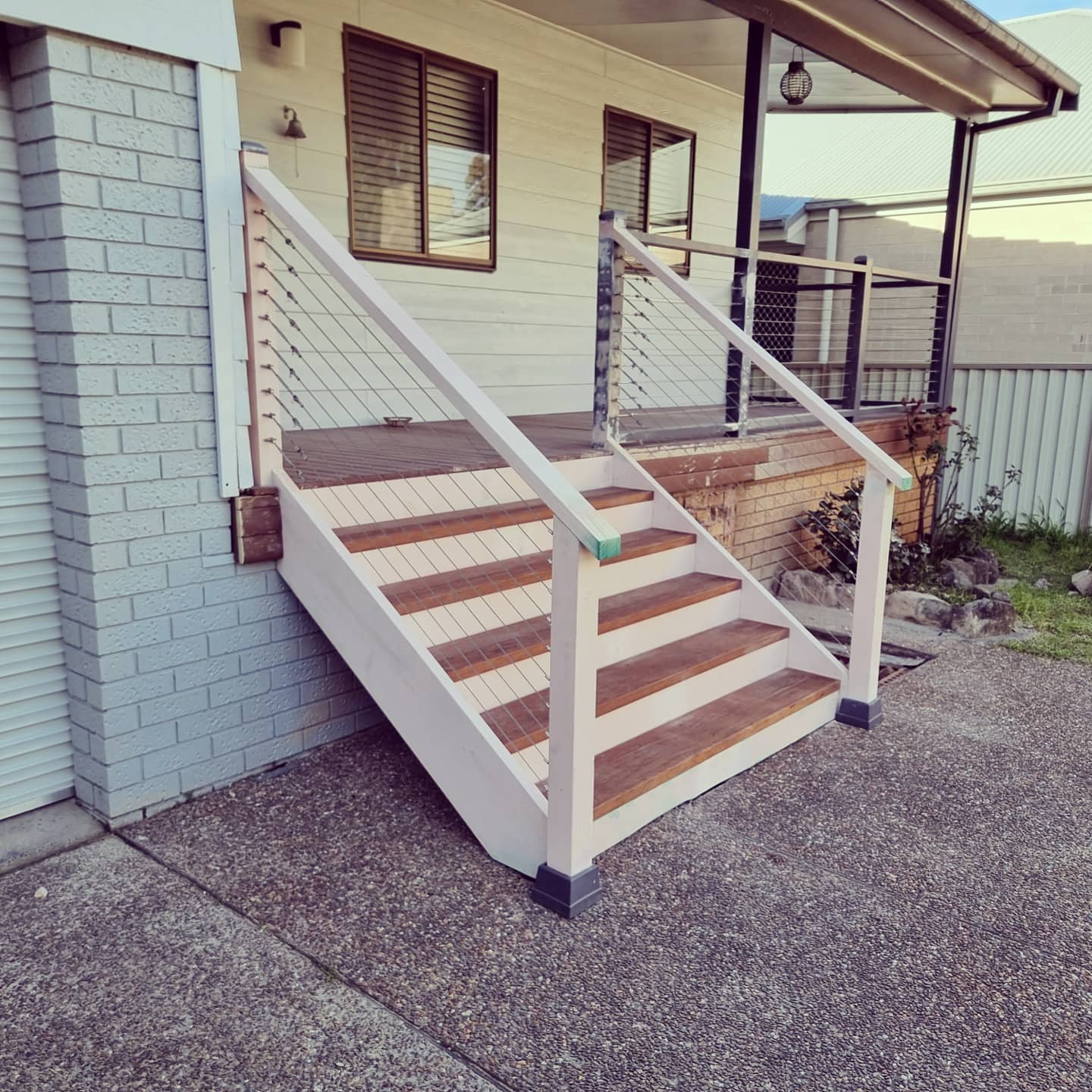
Stair repairs and rebuilds Loose treads, rotted stringers, flexing flights and non-compliant rises. Stairs take more load and more weather than any other part of a deck.
Sanding, oiling and restoration Bringing back a deck that's structurally fine but weathered. Sanding, cleaning, and re-oiling or re-staining.
Post and footing repairs Posts that have taken water at the base, footings that have moved, and stirrup replacement to get timber up off the ground where it belongs.
Is your old deck actually safe?
This is worth taking seriously, particularly on elevated decks built decades ago.
Under the National Construction Code, a balustrade is required where a deck sits 1 metre or more above the surface below. Where it's required, it must be at least 1000mm high, and no opening in it can allow a 125mm sphere to pass through. On stairs the minimum is 865mm measured from the nosing line. Balustrades also have to withstand real loads under AS/NZS 1170.1 — the standard contemplates a person falling against them, not just leaning.
Decks built before those rules were enforced, or built by someone who didn't know them, frequently fall short. The common problems we find on older Central Coast decks:
- Balustrade under 1000mm, or with gaps wide enough for a small child
- Horizontal rails that a child can climb — on decks more than 4m up, horizontal elements between 150mm and 760mm above the deck aren't permitted for exactly this reason
- Balustrade posts fixed to a fascia or a joist end that's since rotted, so the whole rail is held by nothing
- Stair stringers with rot at the bottom where they meet the ground
A balustrade fails when it's loaded. Which means it usually fails when there are a lot of people on the deck — generally the worst possible moment.
If your deck is elevated and more than fifteen or twenty years old, it's worth having someone look at it. We don't charge for the assessment.
Why Central Coast decks fail the way they do
The failure sequence is boringly consistent on this coast.
The fixings go first. Standard galvanised hardware in a salt-exposed position corrodes. Rust bleeds down the boards, which is the visible symptom everyone notices.
Then the fixing loses grip. The board starts to move underfoot.
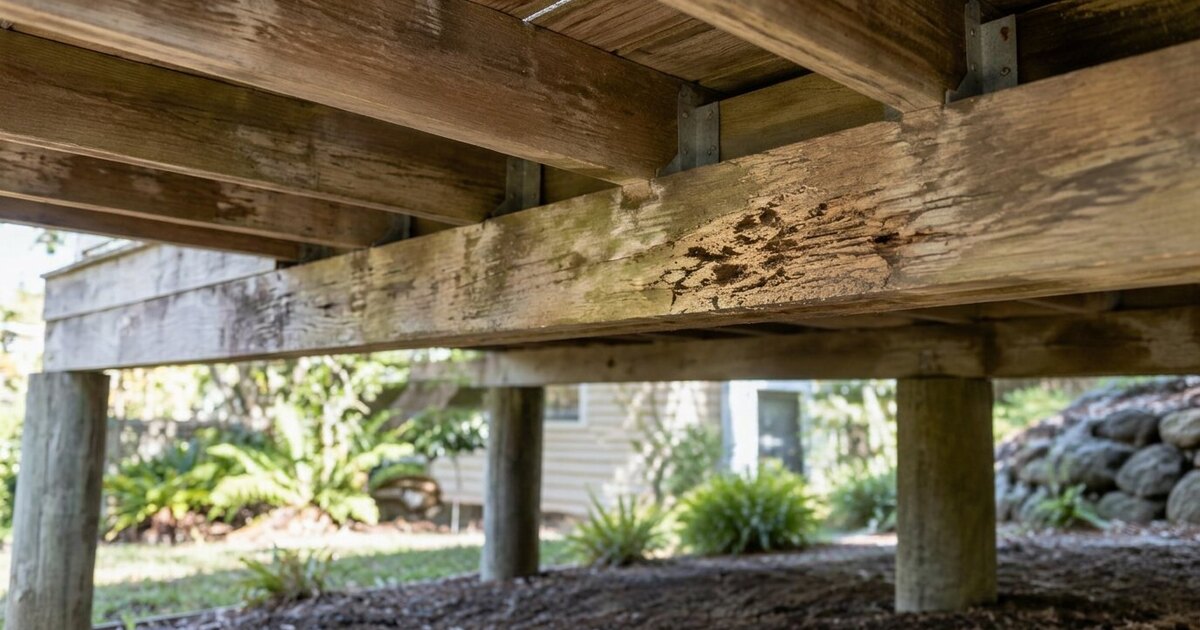
Then water gets in. Movement opens the joint between board and joist, water sits in it, and the top of the joist starts to go — invisible from above, because the board covers it.
Then it's structural. What began as rust stains is now a joist that needs replacing.
Catch it at stage one and it's a fixings job. Catch it at stage four and it's a substructure rebuild. The gap between those two prices is very large, which is the whole argument for looking at a deck before it looks bad.
Local conditions accelerate specific parts of this. On the Woy Woy peninsula, groundwater sitting within half a metre to a metre and a half of the surface attacks anything specified H3 where it should have been H4 or H5. Around Tuggerah Lakes and Brisbane Water — Long Jetty, The Entrance, Tuggerah — flood influence does the same. On the Terrigal, Avoca Beach and Wamberal slopes, it's the post bases and the stair stringers that go first.
Repair or rebuild?
Straight answer: it depends on the frame, and we'll tell you honestly which one you're looking at.
Repair makes sense when the substructure is largely sound and the failures are localised — a few boards, one bearer, a balustrade section, a set of stairs. Most decks are in this category.
Rebuild makes sense when the frame is undersized or widely failed, when the deck was built at a height or spec that was never right, or when you'd be spending 60–70% of a new deck to fix something you'll still be unhappy with.
The one thing we won't do is re-deck over a frame that's going. New boards on a failing substructure looks like a result on handover day and is money thrown at a problem that comes straight back.
What deck repairs cost
Far less than a new deck, in most cases.
Re-decking over a sound existing frame typically runs well under half the cost of a full rebuild, because the substructure — often 40–50% of a new deck — is already there. Localised repairs like a balustrade section, a set of stairs or a few boards are smaller jobs again.
The variable is what we find underneath. That's exactly why we assess before quoting rather than pricing off photos.
Read our full guide: how much does a deck cost on the Central Coast? You may also want 5 signs your deck needs replacing.
How it works
1. Free on-site assessment. We look at the deck from above and from underneath, and check the balustrade and stairs. 2. Straight explanation. What's failed, what caused it, what's still good, and whether repair or rebuild is the right call. 3. Fixed-price quote in writing, with the specification — timber species, treatment levels, fixing types. 4. The work, with anything unexpected raised with you before we proceed, not on the final invoice.
Deck repairs across the Central Coast
We repair decks in Terrigal, The Entrance, Long Jetty, Gosford, Erina, Avoca Beach, Wamberal, Bateau Bay, Blue Bay, Wyoming, Tuggerah and Lisarow. See all areas we service.
Benefits
- Free on-site assessment, including from underneath the deck
- Honest repair-versus-rebuild advice
- Substructure, board, stair and balustrade repairs
- Balustrade brought up to current NCC heights and gaps
- Stainless and coastal-grade fixings on exposed decks
Common questions
- My deck feels soft underfoot. Is that the boards?
- Usually not. Softness and spring are almost always a joist or bearer problem, which means the fix is structural. It is very common on the Central Coast and it is repairable, but it needs looking at from underneath.
- Can I just replace the boards?
- If the frame underneath is genuinely sound, yes — re-decking is much cheaper than a rebuild. If the frame is not sound, new boards over it is money wasted.
- Is my old balustrade legal?
- Possibly not. Current requirements are a minimum 1000mm height where the deck is 1 metre or more above the ground, with no gaps a 125mm sphere can pass through. Plenty of older decks do not meet that, and plenty of balustrade posts are fixed into timber that has since rotted.
- How do I know if my deck is unsafe?
- Movement in the balustrade when you lean on it, sway when you walk, spring underfoot, or flexing stairs are all worth acting on. If the deck is elevated and over fifteen years old, get it looked at.
- Why do decks fail so fast on the coast?
- The fixings corrode first, the board loosens, water gets into the joist, and it becomes structural. Stainless fixings in exposed positions is the single biggest factor in preventing it.
- Can you match my existing decking boards?
- Usually. Board widths and profiles have changed over the years, so a perfect match is not always possible, but we will get as close as the timber allows and tell you honestly what to expect.
- Do repairs need council approval?
- Like-for-like repair and maintenance generally does not. Rebuilding, raising or extending a deck can. We will flag it if it applies.
- Do you charge for the assessment?
- No. Free on-site assessment and a fixed-price quote.
Helpful articles
Read before you start

5 Signs Your Deck Needs Replacing
Not sure if your deck needs repairing or replacing? Learn the five warning signs to watch for on Central Coast homes.
How Much Does a Deck Cost on the Central Coast?
What a deck really costs on the Central Coast NSW — honest per-square-metre ranges, what drives the price up, and how to compare quotes properly.
Timber Decking on the Central Coast NSW: The Pros, the Cons and What You Need to Know
Thinking about timber decking on the Central Coast? Discover the real pros and cons, local climate factors, and Central Coast Council rules before you build.
Termite Damage in Decks and Subfloors: What to Look For This Spring
Spring is termite swarming season on the Central Coast. Learn the signs of termite damage in decks, posts and subfloors, and what to do if you find it.
Where we work
Deck Repairs & Restoration across the Central Coast, including:
Areas we service
Deck repairs across the Central Coast — pick your suburb for local detail.
- Deck repairs Gosford
- Deck repairs Terrigal
- Deck repairs Erina
- Deck repairs Avoca Beach
- Deck repairs Wamberal
- Deck repairs Bateau Bay
- Deck repairs Blue Bay
- Deck repairs The Entrance
- Deck repairs Long Jetty
- Deck repairs Killarney Vale
- Deck repairs Wyoming
- Deck repairs Tuggerah
- Deck repairs Lisarow
- Deck repairs Narara
- Deck repairs Kincumber
- Deck repairs Umina Beach
- Deck repairs Woy Woy
- Deck repairs Ettalong Beach
Ready to build?
Let's talk about your project.
Free, no-obligation quotes across the Central Coast. We usually respond within one business day.