Every deck quote conversation starts the same way. Someone has googled the price, found a number, and it's nowhere near what a real deck costs.
That's not their fault. The published figures are genuinely useless. A quick search right now turns up Australian deck costs quoted anywhere from $120 per square metre to over $1,300 — a tenfold spread, for the same words. Some of those numbers are materials only. Some are a ground-level treated pine platform with no balustrade, no stairs and no approval. Some are supplier marketing designed to get you to the checkout.
So here's an honest answer for the Central Coast, what actually drives the number up or down, and how to tell a real quote from one that's going to change.
The short answer
On the Central Coast, a professionally built deck generally lands between $450 and $1,000+ per square metre, fully installed.
That's a wide range, and the width is the point — where you sit in it is decided by things you mostly can't change. A ground-level hardwood deck on a flat, accessible Long Jetty block sits near the bottom. An elevated multi-level deck on a Terrigal slope with engineer-designed footings, glass balustrade and stairs sits at the top or beyond it.
For a sense of scale:
- 15m² (small courtyard deck) — $7,000 to $15,000
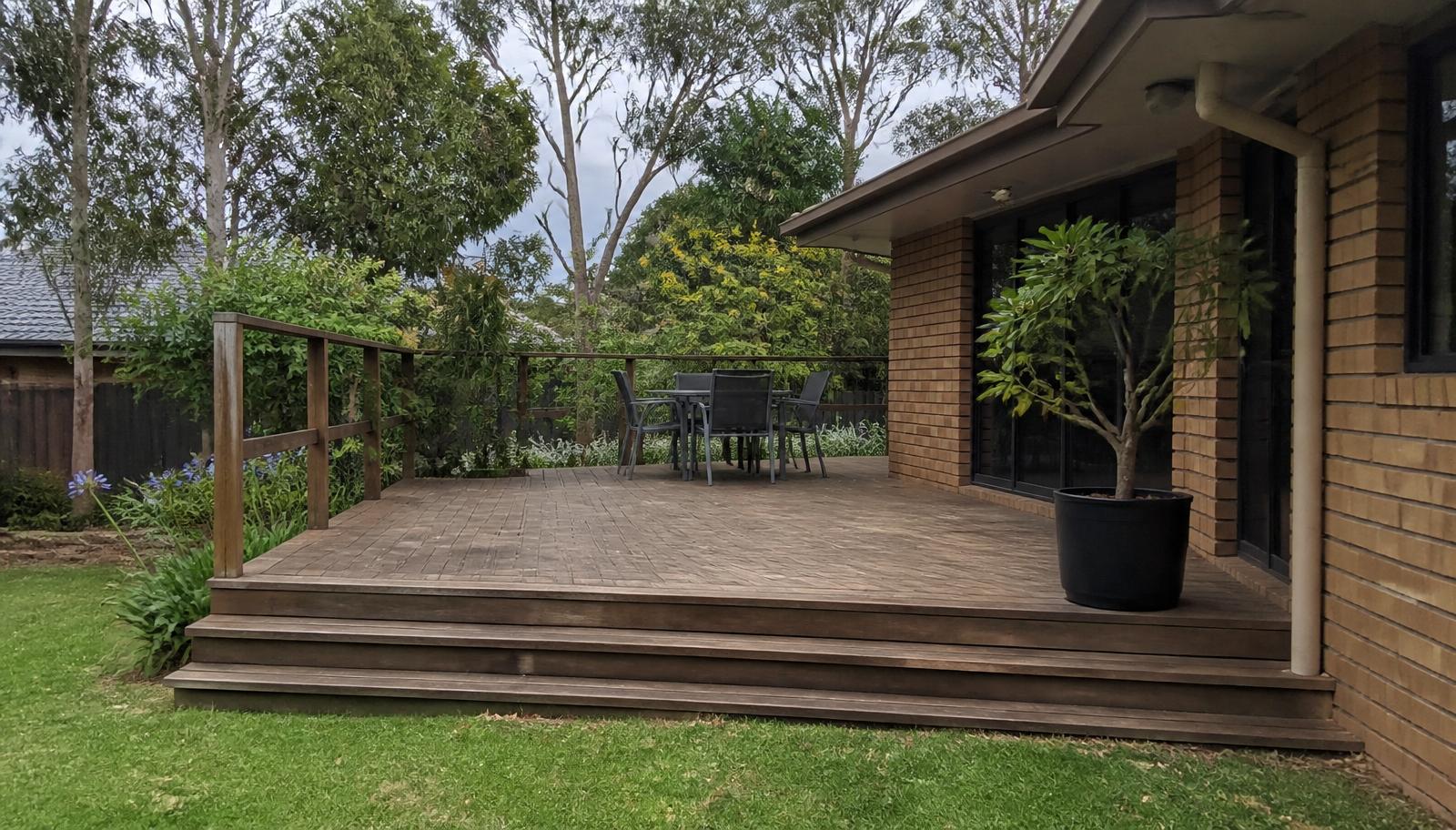
- 25m² (typical rear deck) — $11,000 to $25,000
- 40m² (entertaining deck) — $18,000 to $40,000
- 60m²+ (large or multi-level) — $27,000 to $60,000+
These are indicative only. Nobody can price your deck without standing on your block.
What you're actually paying for
The single biggest misunderstanding about deck pricing is that people think they're buying boards. You're not. On most jobs the boards are a minority of the cost.
A deck quote covers:
- The substructure — footings, posts, bearers, joists, bracing. This is frequently 40–50% of the build, and it's the part nobody sees.
- Footings and groundwork — excavation, concrete, stirrups. Highly variable depending on ground conditions.
- Decking boards — the visible part, and the part people fixate on.
- Fixings and hardware — more significant on the coast than most people realise.
- Balustrade and stairs — often 20–30% of the total when required.
- Labour — the largest single line on most jobs.
- Finishing — sanding, oiling or sealing.
- Approval, engineering and certification — where required.
- Waste removal and site clean.
If a quote is dramatically cheaper than the others, the difference is almost always hiding in the substructure, the fixings or the exclusions.
What pushes the price up
Height off the ground
The biggest single driver. A deck sitting 300mm above ground needs minimal posts, shallow footings and no balustrade. Lift the same deck to 1.5 metres and you've added structural posts, deeper engineered footings, bracing, a compliant balustrade and probably a set of stairs.
The deck is the same size. The cost can be double. This is why identical-sized decks in Long Jetty and Terrigal are not identical jobs.
Ground conditions
Central Coast ground varies enormously over short distances, and it goes straight into the footing cost.
On the Terrigal, Avoca Beach and Wamberal slopes, you can hit rock at 300mm in one corner and be into fill in the next. Rock costs time and equipment.
On the Woy Woy peninsula, groundwater in many properties sits within half a metre to a metre and a half of the surface, in sand that moves when saturated. That changes footing design and treatment levels.
Near Tuggerah Lakes and Brisbane Water, flood influence means H4 or H5 treatment where H3 would otherwise do.
Anyone who quotes without walking your block hasn't priced your footings — they've guessed.
Site access
If materials can be carried through a side gate, that's one price. If they have to go over a fence, down three metres, or up a Terrigal driveway by hand, that's a different one. Access is one of the most underestimated cost lines in decking.
Material choice
- Treated pine — cheapest entry, needs the most maintenance, shortest life in coastal conditions
- Merbau — popular, stable, bleeds tannin early on
- Spotted gum / blackbutt — strong performers in Central Coast conditions
- Ironbark / tallowwood — very durable, harder to work, premium price
- Composite — higher upfront, far lower maintenance, still needs a proper timber or aluminium frame underneath
The gap between pine and premium hardwood on a 30m² deck is real but rarely decisive. The gap between a good substructure and a cheap one matters more. If you're weighing materials, read our guide on composite decking on the Central Coast.
Balustrade and stairs
Once a deck is more than a metre above ground, balustrade is a compliance requirement, not a design choice. Timber balustrade is the cheapest, aluminium sits in the middle, frameless glass is a substantial addition — and on view blocks at Terrigal, Avoca and Wamberal it's often the whole reason for the deck.
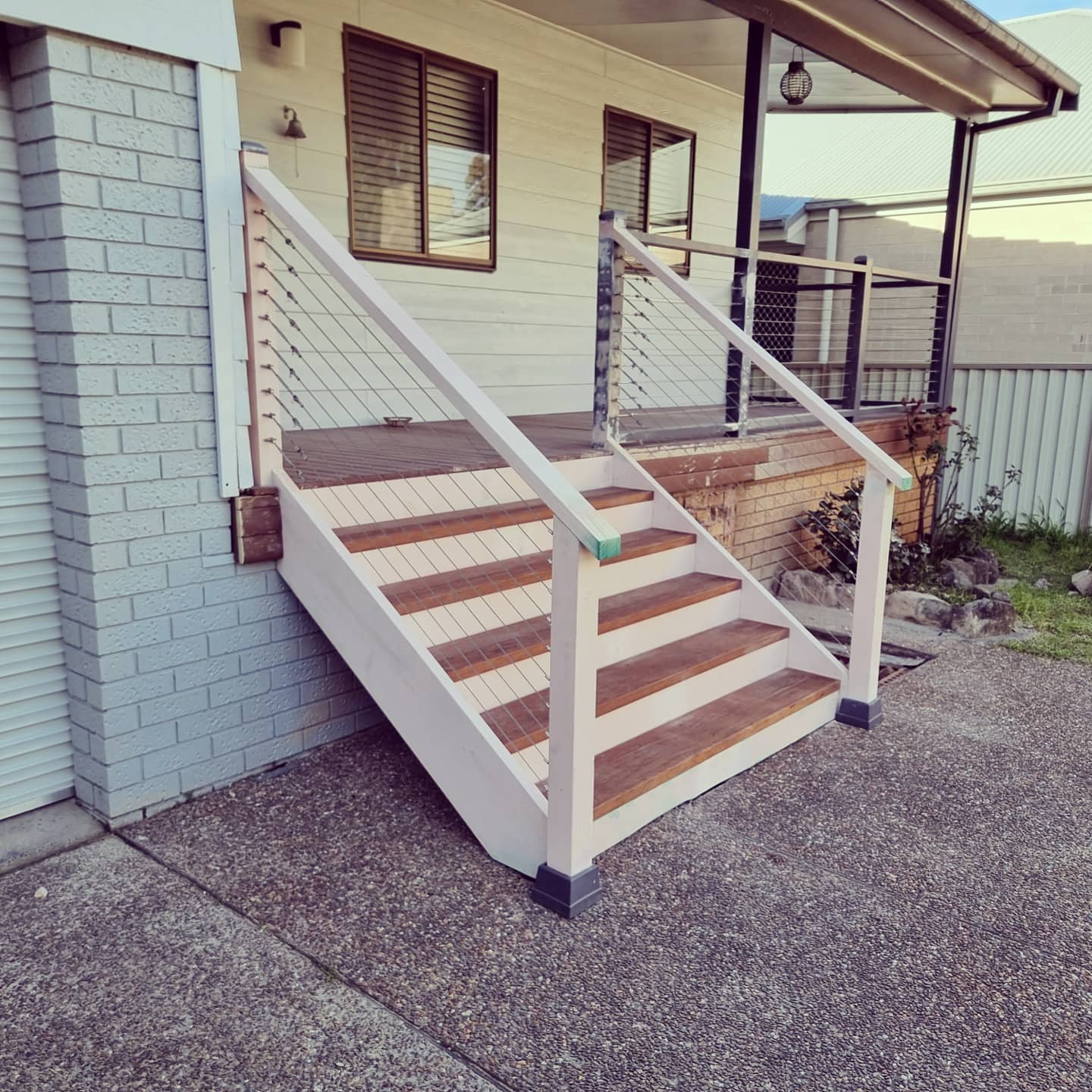
Stairs are priced per flight, and a long flight down a slope is a significant item.
Coastal specification
This is the Central Coast line that most published cost guides ignore entirely.
Standard galvanised fixings in an exposed coastal position will bleed rust down your boards within a couple of seasons. Once a fixing loses grip, the board moves, water gets into the joist, and a cosmetic problem becomes a structural one.
Stainless fixings, sealed board ends and posts on galvanised stirrups add meaningfully to a quote. They also roughly double how long the deck stays good. If you're comparing two quotes and one is notably cheaper, ask what fixings are specified — this is where the difference usually is.
Approvals
Some decks need no approval at all. Others need a certifier or a full council application.
If your deck is 25m² or less, sits no more than 1 metre above ground, is set back at least 900mm from every boundary and meets the other standards, it can be exempt development — no application, no fee, no waiting.
Above that you're looking at a Complying Development Certificate (roughly a 10-day process through a private certifier) or a Development Application through Central Coast Council, which takes longer and needs more documentation including a Statement of Environmental Effects.
Certifier fees, engineering and application costs are real budget lines. On a sloping or constrained block they're unavoidable. Read our full guide: Do I need council approval for a deck or pergola on the Central Coast?
Repairs and re-decking cost far less
If your existing substructure is sound, replacing just the boards is a fraction of a new build — often less than half.
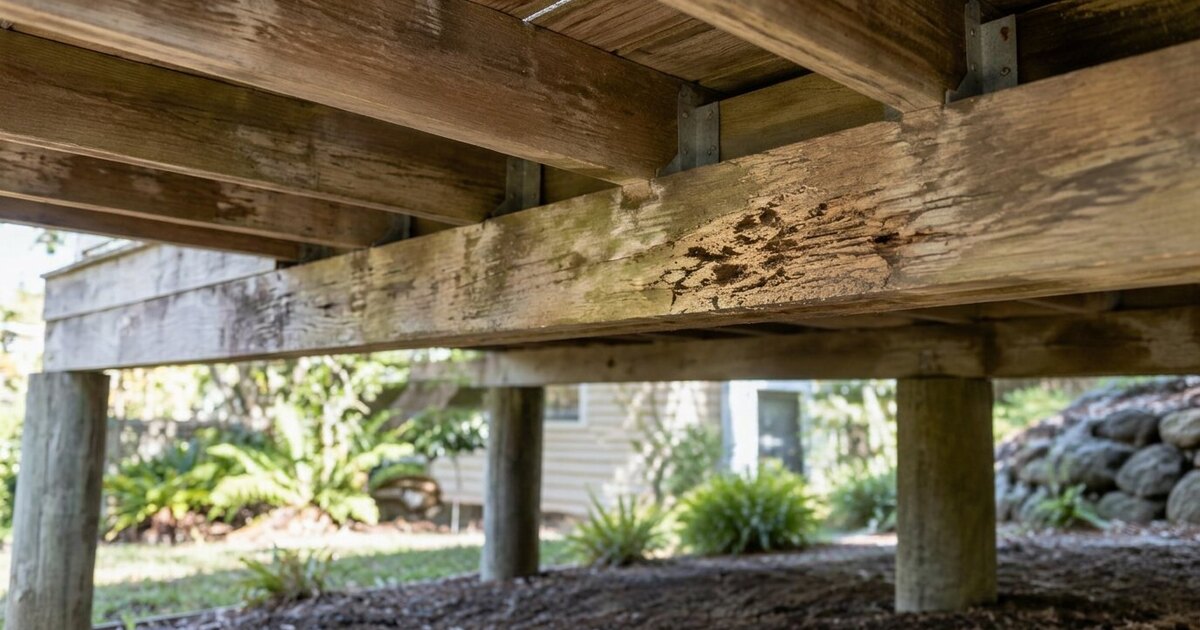
The catch is that on the Central Coast the substructure frequently isn't sound. Softness underfoot is almost never a board problem; it's usually bearers or joists. We assess from underneath before quoting either way, because re-decking over a failing frame is money thrown at a problem that comes back. See repairs and maintenance or the signs your deck needs replacing.
What a proper quote should include
Ask for these in writing. A quote that can't answer them isn't a fixed price:
- Timber species and treatment level — not "hardwood", but which hardwood, and H3, H4 or H5 on the substructure
- Joist and bearer spacing, and confirmation the spec follows AS 1684
- Fixing type — stainless or galvanised, and where each is used
- Footing type and assumed depth, plus what happens if rock or unexpected ground is hit
- Whether balustrade and stairs are included
- Whether approval, engineering and certification costs are included or excluded
- Waste removal and site clean
- Builder's licence number — verifiable on the Service NSW public register
Why the cheapest quote usually isn't
Three quotes on the same deck can vary by 40%. The difference is rarely profit margin.
Common places the gap hides: galvanised fixings instead of stainless, H3 substructure where the ground needs H4, wider joist spacing, footings priced on an assumption nobody checked, and approval costs quietly excluded so they land as a variation.
A cheap deck on the Central Coast is usually a normal deck with the coastal specification removed. It'll look identical on handover day. The difference shows up in year six.
The cost nobody quotes: maintenance
An oiled hardwood deck here needs re-oiling roughly annually, and more often on exposed north and west faces.
Stay on top of it and a well-built hardwood deck is sound well past twenty years. Leave it five years and you're not re-oiling, you're re-sanding. Leave it ten and you're replacing boards.
That's the real argument for composite. It costs more upfront and it doesn't remove the need for a properly specified frame underneath, but over a fifteen-year horizon the maintenance difference is substantial — particularly on an exposed block where timber works hardest.
Frequently asked questions
How much does a deck cost per square metre on the Central Coast?
Generally $450 to $1,000+ per square metre installed. Ground-level decks on flat, accessible blocks sit at the lower end; elevated decks on sloping blocks with balustrade and stairs sit at the upper end.
Why are online deck prices so much cheaper than my quotes?
Because most published figures are materials-only, or a ground-level pine platform with no balustrade, stairs, footings or approval. Published Australian figures range from around $120/m² to over $1,300/m², which tells you how little the number means without context.
What's the cheapest way to build a deck?
Keep it at ground level, keep it simple in shape, keep it under the exempt development limits so you avoid approval costs, and make sure access is easy. Don't save money on the substructure or the fixings.
Is composite more expensive than timber?
Upfront, generally yes. Over ten to fifteen years the gap narrows considerably once oiling, sanding and board replacement are counted. It still needs a properly built frame underneath.
Does a deck add value to my home?
On the Central Coast, usually — outdoor living is a major part of how homes here are used and sold. A well-built deck that suits the house adds more than an oversized one that doesn't.
How long does it take to build?
A straightforward ground-level deck is typically several days to a week on site. Elevated and multi-level decks take longer. Add roughly 10 working days if a CDC is required, or considerably more for a DA.
Do I need approval, and does that cost extra?
Sometimes not. Decks up to 25m², under 1m high and set back 900mm from boundaries can be exempt. Beyond that, certifier or council fees plus engineering apply and should be in your quote, not a surprise later.
Can you give me a price over the phone?
We can give you a range. We won't give you a fixed price without seeing the block, because footings, access and ground conditions are exactly where phone estimates go wrong.
Get a real number for your deck
Free on-site assessment, honest advice on the approval pathway, and a fixed-price quote with the specification in writing. Request a free quote or explore our deck building services.
Servicing Terrigal, The Entrance, Long Jetty, Gosford, Erina, Avoca Beach, Wamberal, Bateau Bay and the wider Central Coast.
Prices in this guide are indicative for 2026 and are general information only. Every site is different — costs vary with ground conditions, access, design and approval requirements.
Related services
If your existing deck is the reason you are pricing a new one, get it looked at first — plenty of decks are repairable for a fraction of a rebuild. See Deck Repairs & Restoration for what we assess and fix, or Deck Builders & Decking if you are building new.
Planning a deck near a pool? The 900mm non-climbable zone around a pool barrier catches a lot of people out, and deck edges count. Read Fencing before you set out the deck.
Related services
Ready to move from planning to build? Explore the services we cover on the Central Coast: